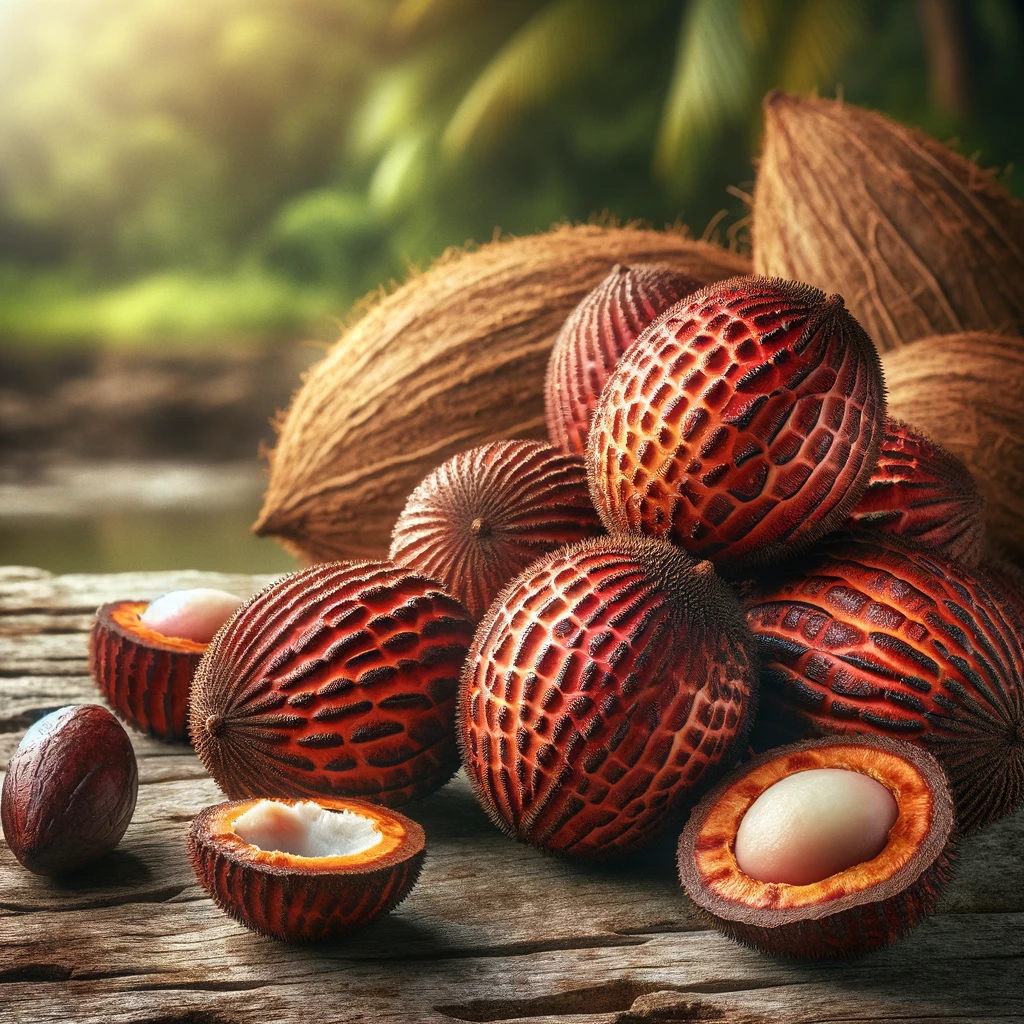
Those little scaled fruits belong to a tall rainforest palm. Their orange flesh gives us an oil naturally rich in carotenoid pigments, including beta-carotene. A tiny fruit with a very big personality.
The plant
Mauritia flexuosa
The part we use
The orange fruit pulp of the buriti palm
The roots
Tropical South America
Why it belongs in the blend
A little more to love.
Buriti brings a fluid, oleic-acid-rich oil to our butter blend. As an emollient, it helps skin feel soft and leaves a light conditioning film. The orange color comes from the fruit itself.
For your skin
Buriti’s oil is rich in oleic acid, with carotenoid pigments from its orange fruit. An emollient oil spreads over the skin surface, softening dry-feeling areas and adding slip. I love that fluid feel beside the richer butters, especially on clean, slightly damp skin after a day outdoors.
Hair, curls & beard
A tiny amount on dry lengths can add slip and help flyaways lie a little smoother. Try the ends first, or warm what remains on your palms through a beard. Buriti’s orange pigments can mark pale fabrics, and pure oil can tint very light hair.
Beyond the ingredient
A rainforest story worth knowing
Buriti’s golden-orange color begins with the fruit of a South American palm. The pulp holds the oil and its naturally occurring carotenoid pigments. I choose it for the softness and fluidity it brings to the richer butters. A little rainforest character in a very small scoop.
Buriti-containing creams have been studied in laboratory cell tests for their response to UV exposure. That is an interesting research trail, not a sun-protection rating for our tin. The useful everyday job here is emollient care: a conditioning layer, softness and glide. Wear a tested sunscreen for sun protection.
Sources checked October 4, 2026. These plant stories offer context for the ingredients. Studies of individual ingredients do not establish clinical results for the finished ganache.